Upload Files to Google Cloud Compute Engine
Linux
To transfer files to Compute Engine VM instances, dissimilar options are available depending on your workstation Bone and the target VM example OS.
| Transfer from | To Linux VMs |
|---|---|
| Linux or macOS |
|
| Windows |
|
Transfer files through Cloud Storage
Cloud Storage buckets can be a convenient intermediate transfer point between you and your VMs.
This file transfer method works on almost all operating systems and VM types as long as your VM has access to your Cloud Storage bucket through a service account or through your personal user credentials.
Upload your files from your workstation to a Cloud Storage bucket. Then, download those files from the bucket to your instances.
- Create a Deject Storage bucket or identify an existing bucket that y'all want to use to transfer files.
- From your workstation, upload files to the bucket.
- Connect to your VM using SSH.
- On your VM, download files from the saucepan.
If you need to transfer files in the other direction, reverse the process. Upload the files from your VM, then download those files to your workstation.
Transfer files using SSH in the browser
If you can establish an SSH connection to a VM using the SSH from the Browser window, you can utilise that connexion to transfer files to the VM.
- In the Cloud Console, go to the VM instances page.
Go to VM instances
- In the list of virtual machine instances, click SSH in the row of the instance that y'all want to connect to.

- Later on the connectedness is established, click the gear icon in the upper right of the SSH from the Browser window and select Upload file. Alternatively, select Download file to download a file from the VM.

- The transfer dialog opens. Specify which file you lot want to transfer.
If you lot uploaded a file, the file is in your /home/USER directory.
If you downloaded a file, the file is in the default download binder on your local workstation.
Transfer files using the Google Cloud CLI
The Google Cloud CLI provides an SCP file transfer utility, creating an SSH key pair for you the beginning time you connect. Your private key is stored on your local device and its corresponding public key is copied to project or VM instance metadata.
To transfer files using SCP, you must have a firewall rule on the network that your VM uses that allows SSH connections on port 22. You can verify that this firewall rules exists by looking for a firewall rule that allows tcp:22 connections in the Google Cloud Console.
Become to Firewall rules
If you don't have a firewall rule that allows SSH connections on port 22, create the firewall rule.
Y'all can install the gcloud CLI and use it to copy files and directories to your VM using the scp command.
The following example copies a file from your workstation to the habitation directory of the VM.
gcloud compute scp LOCAL_FILE_PATH VM_NAME:~
Replace the following:
-
LOCAL_FILE_PATH: the path to the file on your workstation -
VM_NAME: the name of your VM
You lot can also re-create files and directories from a VM to your local workstation. The following example recursively copies a directory from your VM (the source) to your local workstation (the destination).
gcloud compute scp --recurse VM_NAME:REMOTE_DIR LOCAL_DIR
Replace the post-obit:
-
VM_NAME: the name of the VM -
REMOTE_DIR: the path to the directory on your VM -
LOCAL_DIR: the path where you lot want to put the directory on your workstation
For more data, see the gcloud compute scp reference documentation.
Transfer files using SCP on Linux and macOS workstations
The scp control-line tool works similarly to the gcloud compute scp command but requires you to manually manage your SSH keys.
To transfer files using SCP, you must take a firewall dominion on the network that your VM uses that allows SSH connections on port 22. You can verify that this firewall rules exists past looking for a firewall rule that allows tcp:22 connections in the Google Cloud Console.
Go to Firewall rules
If you don't have a firewall rule that allows SSH connections on port 22, create the firewall rule.
The scp tool uses the aforementioned fundamental files that you lot employ to connect to your instances using standard SSH.
-
If you have not yet applied a public key to your Google Cloud Panel project or VM instance, create an SSH fundamental pair and add together the public key to project or instance metadata.
-
Find the external IP for the VM that yous want to send files to. In the Google Cloud Console, go to the VM instances page.
Go to VM instances
-
Utilise the
scptool to copy a file from your workstation to the domicile directory of the target VM. For this example, the individual key is at~/.ssh/my-ssh-fundamental.scp -i ~/.ssh/my-ssh-cardinal LOCAL_FILE_PATH USERNAME@IP_ADDRESS:~
Replace the following:
-
LOCAL_FILE_PATH: the name of the local file that y'all desire to upload -
USERNAME: your username -
IP-Address: the external IP address for your VM
-
You lot can also copy files from a VM to your local workstation past reversing the source and destination variables. For this example, copy a file from your VM to a path on your workstation.
scp -i ~/.ssh/my-ssh-key USERNAME@IP_ADDRESS:REMOTE_FILE_PATH LOCAL_FILE_PATH
Replace the post-obit:
-
USERNAME: your username -
IP_ADDRESS: the external IP address for your VM -
REMOTE_FILE_PATH: the name of the remote file that you lot want to download -
LOCAL_FILE_PATH: the location on your workstation where you lot desire to download the file to
Transfer files using WinSCP on Windows workstations
On Windows workstations, the WinSCP client lets you manage files on your instances through a graphical file browser interface.
WinSCP uses the same key files that you lot use to connect to your instances using PuTTY.
-
Practice the following if you haven't configured key-based SSH authentication for your case:
-
Create an SSH fundamental pair.
-
Add your public SSH fundamental to your project'south metadata or to your VM's metadata. For more information, meet Add SSH keys to project metadata or Add SSH keys to instance metadata.
-
-
Notice the external IP for the VM that you want to send files to.
- In the Google Cloud Console, go to the VM instances page.
Go to VM instances
- In the listing of VMs, discover the external IP address in the External IP column for your VM.
- In the Google Cloud Console, go to the VM instances page.
-
Download and install WinSCP. The default install settings work for well-nigh users.
-
Beginning the WinSCP programme. A login window opens where you tin can configure your connection settings.
-
In WinSCP, configure your connection settings.
-
Select
SCPequally the file transfer protocol in the File protocol field. -
In the Host Name field, specify the external IP address for the VM that you want to connect to.
-
In the User name field, specify the Google username that you use to access your project. For this example, the user is
example-user.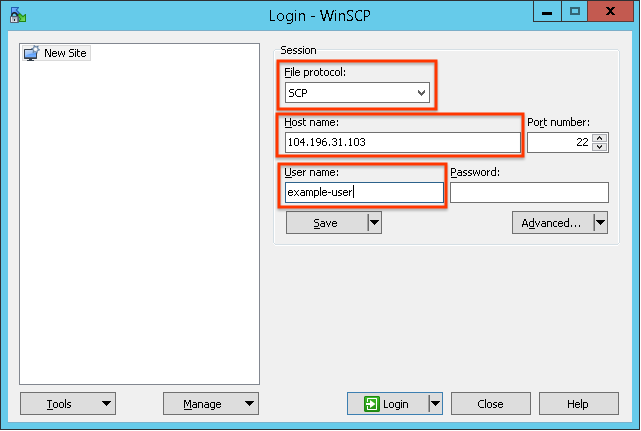
-
-
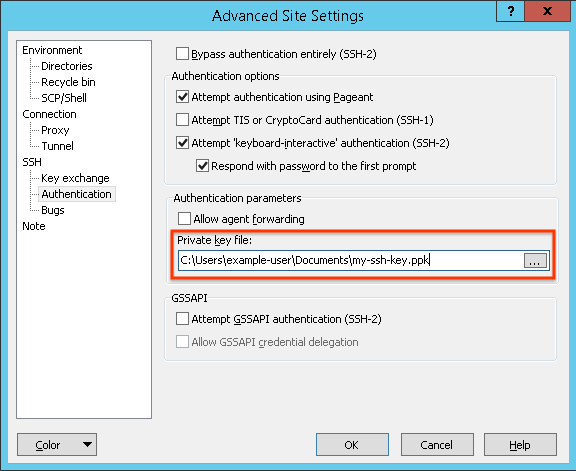
Click the Advanced drib-downward list to open the avant-garde settings, and navigate to SSH > Hallmark.
-
In the Private primal file box, specify the path to your individual central file of the SSH key pair that you lot created for the VM.
-
Click Ok to save the avant-garde settings.
-
Click Login to connect to your VM. If the connection is successful, the window opens your local file system on the left and the VM's file arrangement on the right. Y'all can navigate to unlike directories in these file systems and drag files to transfer them to and from your VM.
-
You probable do not have permission to manage most files outside of your home directory of the VM. Navigate to the home directory of the VM:
/home/USERNAME
-
Use the WinSCP interface to move files between your workstation and the VM.
-
After you copy your files to the VM, connect to your instance so that you tin can execute or move files with full
sudopermissions.
What'south side by side
- Connect to your instances to use the files that you uploaded.
Source: https://cloud.google.com/compute/docs/instances/transfer-files#:~:text=In%20the%20Cloud%20Console%2C%20go%20to%20the%20VM%20instances%20page.&text=In%20the%20list%20of%20virtual,window%20and%20select%20Upload%20file.
0 Response to "Upload Files to Google Cloud Compute Engine"
Post a Comment