What governmental concept allows Georgia to create its own constitution?
| Constitution of the State of Georgia | |
|---|---|
| Overview | |
| Jurisdiction | Georgia, United states |
| Created | 25 September 1981 (1981-09-25) |
| Ratified | 2 November 1982 (1982-eleven-02) [ane] |
| Location | Georgia Archives |
The Constitution of the State of Georgia is the governing document of the U.S. Country of Georgia. The constitution outlines the three branches of government in Georgia. The legislative branch is embodied in the bicameral Full general Associates. The executive branch is headed by the Governor. The judicial branch is headed by the Supreme Courtroom. Besides providing for the organization of these branches, the Constitution advisedly outlines which powers each branch may do.
The current Georgia State Constitution was ratified on November 2, 1982. It is the newest state constitution in the Us and is Georgia's 10th Constitution, replacing the previous 1976 constitution.[1]
Amendments to the Constitution may be proposed in the Georgia legislature and must be approved by a two-thirds majority vote of both the state Business firm and state Senate followed by ratification by a majority of the electors qualified to vote for members of the General Assembly at the next full general election which is held in the even-numbered years. The Constitution can likewise exist amended by proposal at a ramble convention, the calling of which must receive the support of a two-thirds majority vote by both houses of the legislature and a simple majority of country voters.
History [edit]
Georgia has had ten different constitutions in its history, not counting its royal charter, granted in 1732. The charter, approved by George II of Great Britain (the colony's namesake), placed Georgia under the control of Trustees, led by James Oglethorpe. The Trustees governed Georgia until 1752, when they surrendered their charter. Georgia then became a crown colony.[two]
Antebellum constitutions (1776, 1777, 1790, 1798, and 1861) [edit]
Prior to having a formal constitution, a document entitled Rules and Regulations of the Colony of Georgia, drafted in 1776, was in effect.[3] This document was designed to be temporary and made the Provincial Congress the near powerful branch of government.[4] A year subsequently, in 1777, the showtime formal constitution was drafted. This document also fabricated the legislature the about powerful co-operative, with the governor being forced to rely on his executive council for many decisions. Additionally, the constitution allowed for an expansive franchise, with only the poorest excluded.[five] These provisions resulted from the domination of the 1777 convention by "radicals" as opposed to the more moderate faction found in other states.[6]
The adoption of the new federal constitution obliged Georgia to implement a new country one. Following three dissever conventions,[seven] a new constitution was adopted in 1789. The new document replaced the unicameral Congress with a bicameral General Assembly. The executive council was abolished, and the legislature given power to elect the governor. Additionally, liberty of voice communication, trial by jury, and freedom of organized religion were guaranteed.[8] In 1795, a convention met to amend the recently-adopted constitution.[9] These amendments reapportioned the Business firm of Representatives amongst the counties, with each county receiving one state senator. Additionally, the country capital was moved from Savannah to Louisville, and another convention scheduled for 1797 to further amend the document.[8]

James Jackson, leader of the 1798 convention
In between the two conventions, the Yazoo country scandal dominated Georgia politics. The majority of the state legislature became implicated in the scandal, which involved Georgia's western lands (present-twenty-four hour period Alabama and Mississippi). Every bit a result, a number of legislators lost re-election, and reforms to property laws were enacted by their successors.[10] Shortly later on, the convention authorized in 1795 was postponed until 1798. James Jackson, Georgia's former U.S. Senator, played the ascendant role in this convention as the governor at the time.[11] The constitution produced past this new convention bore several similarities to the 1789 constitution. While the House was apportioned past population, each canton was withal guaranteed at least one representative. Notably, the new document prohibited state sales similar to those which prompted the Yazoo fraud.[12] The 1802 cession past which Georgia transferred its western lands to the federal government rendered much of this provision moot, though it nevertheless applied to those lands Georgia eventually gained following the removal of the Cherokee people.[13] This constitution would be amended xx-three times before the Civil State of war.[fourteen]
Just before the start of the Civil War, Georgia'south Secession Convention drafted a new constitution for the state, led largely by Thomas Reade Rootes Cobb, the Convention's chairman.[xv] The new constitution largely left in identify the framework of government found under the 1798 constitution, as amended. It did, still, include a longer bill of rights which was not found in the 1798 certificate.[sixteen]
Post-bellum constitutions (1865, 1868, and 1877) [edit]
Following the Civil State of war, a new constitution was drafted in 1865. In the backwash of the war, the federal government oversaw the country'southward transition back into the Spousal relationship. President Andrew Johnson appointed a conditional governor, who then convened a convention to draft a new constitution.[17] The document retained many of the provisions of the 1861 constitution, including the bill of rights it had introduced. Major changes included a two-term limit for governors and the legislative election, rather than gubernatorial appointment of the Supreme Court. Additionally, Superior Court judges became popularly elected.[18] The convention besides abolished slavery in the state, although with slap-up reluctance.[19] Indeed, the constitution labeled the abolitionism of slavery "a war measure" past the federal authorities and too provided for compensation to slaveholders for the loss of their holding.[xviii]

The 1868 Constitution moved the state majuscule to Atlanta. Shown here is Peachtree Street in 1875.
The 1865 Constitution had been adopted during the era of Presidential Reconstruction. In 1866, nevertheless, Congress passed the Military Reconstruction Acts, which placed Georgia and other onetime Confederate states nether military rule. Equally a issue, African Americans began to participate in the state regime, along with "scalawags" who cooperated with the U.S. armed forces.[20] This new state government called for another convention to prefer a new constitution in 1868. Additionally, a number of "carpetbaggers," Northerners who moved to the South following the state of war, participated in the convention.[21] The new land constitution aimed to provide rights for African Americans and promote racial equality in the state. Its beak of rights incorporated the 14th Amendment into the state constitution, and suffrage was granted to all males over the age of 21 regardless of race. The state regime also was tasked with creating a system of public education. Additionally, the governor'southward term of office was extended to four years, with no limit, and the do of electing judges was ended. The certificate also required amendments to be approved by popular vote rather than but past the country legislature and moved the capital letter to Atlanta.[22]
In 1870, Georgia was readmitted to the Union, and, past 1872, Democrats regained command of the state legislature. Many of these Democrats identified as Bourbons, a faction representing the antebellum elite.[23] With their return to power, the old elites quickly saw the need for a new constitution and chosen for a convention in 1877 to draft one.[24] While much of the authorities structure remained the same, the new constitution restricted the power of the legislature significantly, including an two articles devoted to taxation and land finances.[25] The ii-year term for governors was reintroduced, forth with the two-term limit. The certificate, in a reversal from 1868, mandated the segregation of the land's public schools. A prohibition of the creation of new counties was as well included.[26] Following its adoption, the 1877 constitution was amended numerous times. Many dealt with the construction of government, altering legislative circulation and powers, introducing popular elections of judges. 188 amendments solitary were made to Article Seven, concerning state finances, mostly in regard to specific cities and counties. A number of new counties were besides created by amendment.[27] Most notably, an subpoena in 1943 lowered the voting age to eighteen. This amendment made Georgia the first land to do then.[28]
20th-century constitutions (1945 and 1976) [edit]
All constitutions up until 1945 were drafted by constitutional convention.[29] That yr, Governor Ellis Arnall appointed a twenty-three fellow member commission, composed of all three branches of government, to write a new constitution.[1] In August 1945, a popular vote ratified the new document. The new document, all the same, did not represent a smashing alter from the old constitution. 90% of the 1877 constitution's provisions (every bit amended) remained intact.[30] Once again, an extensive bill of rights was included in the new document. The new document also made permanent several changes fabricated over the years, including setting the voting age at eighteen and the introduction of a literacy test for voters. Other changes included provisions dealing with agencies created after 1877, including the State Board of Corrections and the office of Commissioner of Agronomics. Some changes also affected local government in the state, including a cap on the number of counties at 159 (which remains the case today), and the introduction of provisions for domicile rule.[31]
Subsequent to the new document's adoption, a number of provisions came nether judicial scrutiny and were subsequently struck down. Schoolhouse segregation, mandated by Article VIII, was held to violate the U.Due south. Constitution by the Supreme Courtroom in the 1954 case Brown 5. Board of Education. Georgians resisted the decision, only a number of court decisions somewhen forced the state's residents to comply.[32] The system of legislative apportionment, along with Georgia'due south unique organisation to count votes in main elections, were struck downwardly in 1963 by the Courtroom in the example of Grayness v. Sanders due to their basis in counties rather than population.[33]
These cases led many to consider revisions to the constitution. Efforts in the late 1960s were rejected, however, due to the continued malapportionment of the legislature. In 1974, George Busbee won the gubernatorial election on a platform of constitutional revision. Past the time of Busbee's ballot, the constitution contained 831 amendments and was the nation'southward longest. The 1976 revision, nonetheless, produced little alter beyond reorganizing the document's provisions.[1] [34] These amendments, now incorporated into the constitution, included correcting the legislative malapportionment and the establishment of a Lieutenant Governor position.[35]
Constitution of 1983 [edit]
In 1977, a select committee was created to discuss revision of the 1976 constitution. Members included the Governor, Lieutenant Governor, the Speaker of the Firm, the Attorney Full general, representatives of the General Assembly and the judicial co-operative.[i] Understanding on a constitution was made in August 1981 and in August and September of that year the document was submitted to the General Associates in a special session.[1] The constitution was approved on 25 September 1981 and went to vote in the general ballot and was ratified on two November 1982. The current Constitution streamlined the previous one and did away with authorization for local amendments.[36]
Manufactures of the Constitution [edit]
The Constitution consists of a Preamble and eleven Articles.
Preamble: Statement of Purpose [edit]
To perpetuate the principles of gratis government, insure justice to all, preserve peace, promote the involvement and happiness of the citizen and of the family, and transmit to posterity the enjoyment of freedom, we the people of Georgia, relying upon the protection and guidance of Almighty God, practice ordain and constitute this Constitution.[37]
The Preamble to the Georgia Country Constitution is a brief introductory statement describing the principles which the Constitution is meant to serve. Information technology expresses in full general terms the intentions of its authors. Information technology does non grant nor prohibit any dominance to the state regime. All the same, it has at times been used by the Supreme Court of Georgia to assist in deciding a case. For instance, the Preamble was cited in 1982 in Roberts v. Ravenwood Church of Wicca, and later the portion of the Preamble which states "...promote the interest and happiness of the citizen and of the family..." was used in several court cases regarding family issues such as Clabough v. Rachwal, Dixon 5. Dixon and Arnold five. Arnold.[38] [39]
Commodity I: Bill of Rights [edit]
Article One describes the Georgia Neb of Rights. These are the Rights of Persons, the Origin and Structure of Regime and other General Provisions.[40] The first Section, the Rights of Persons, lists twenty-viii paragraphs of individual rights. Many of these rights are similar to the rights listed in the Us Bill of Rights. Still, there are differences. For case, the Georgia Bill of Rights lists among its freedoms the Freedom of Conscience, which is the "natural and inalienable right to worship God, each co-ordinate to the dictates of that person's own conscience" without interference and adds the correct to religious stance along with freedom of religion.[40] Section II describes the "origin and foundation of government", the "object of government" the separation of powers and the superiority of civil potency over armed forces say-so. Also, this section explicitly describes the separation of church building and country.[twoscore] Finally, Section III, Full general Provisions, deals with Eminent Domain, private ways and Tidewater titles.[40]
Article II: Voting and Elections [edit]
Commodity Two describes Voting and Elections in Georgia. Specifically, the three Sections of the Article bargain with the method of voting and the right to register and vote; general provisions and suspension and removal of public officials.[41]
Commodity III: Legislative Branch [edit]
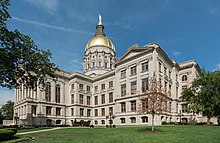
Article Three describes the Legislative Branch of Georgia's government. The Article establishes legislative powers; the General Assembly's composition; officers of the General Assembly; organizations and procedures; the enactment of laws; the exercise of legislative power; method of impeachment; insurance regulation; appropriations; and retirement systems.[42] Representatives must be at to the lowest degree 21 years old, take been a denizen of the land for at to the lowest degree two years, and exist a resident of their district for at to the lowest degree one year.[42] Senators must be 25 years erstwhile, have been a denizen for two years, and live in the district they correspond for at least one year.[42] Commodity 3 establishes meetings, fourth dimension limit and adjournment of the General Assembly and allows each house to establish its ain rules of procedure, provide for its own employees and interim committees may exist created past the General Assembly or by either house.[42]
Article IV: Constitutional Boards and Commissions [edit]
Article Four describes Constitutional Boards and Commissions. This Article consists of seven Sections describing vi boards and commissions and their powers. Section I deals with the creation of a Public Service Commission to regulate utilities. Department II created a State Board of Pardons and Paroles. Section III instituted a State Personnel Board and Section Iv created the State Transportation Lath. Sections V and VI are responsible for the Veterans Service.[43]
Article V: Executive Branch [edit]
Commodity Five describes the Executive Branch of Georgia's authorities. This Commodity is made up of iv Sections. Department I details the election of the Governor and Lieutenant Governor. Section II lists the duties and powers of the Governor. Department III discusses other elected officials and Section Four discusses the inability of executive officers and how to go about choosing a successor should an executive officer become permanently disabled.[44]
Article VI: Judicial Branch [edit]
Article Six describes the Judicial Co-operative of Georgia's regime. This Article contains ten Sections which discuss the different courts and their powers and jurisdictions. Article Six as well details the role of the commune chaser in Georgia's justice organization.[45] Article Six besides solidified the courts which, prior to the electric current constitution, were terribly fragmented.[38]
Article Vii: Revenue enhancement and Finance [edit]
Commodity Seven deals with Taxation and Finance in Georgia. In that location are four Sections, each dealing with the ability of taxation; exemptions from ad valorem tax; purposes and methods of state taxation and country debt.[46] Powers of taxation cited in the Constitution include the limitation on grants of revenue enhancement powers; taxing ability limited and uniformity of taxation. Too included are the nomenclature of holding; assessment of agricultural land and utilities.[46] Sections II and III, dealing with exemptions from ad valorem tax and purposes and methods of state taxation respectively, focus on voiding unauthorized tax exemptions; exemptions from taxation on property; locally authorized exemptions; purposes for which powers may exist exercised regarding taxation; revenue and the full general fund and grants to counties and municipalities. Section Four'due south office regarding state debt is spelled out in eleven different paragraphs.[46]
Article Eight: Pedagogy [edit]
Article Eight of the Constitution describes Education. This Article deals with public schools; boards and offices responsible for education; local school systems; revenue enhancement and educational assistance.[47]
Commodity IX: Counties and Municipal Corporations [edit]
Commodity Nine describes Counties and Municipal Corporations. Article 9 contains vii Sections concerning counties; home rule for counties and municipalities; intergovernmental relations; tax power of canton and municipal governments; limitation on local debt; revenue bonds and community comeback districts.[48]
Article X: Amendments to the Constitution [edit]
Article 10 of the Constitution describes Amendments to the Constitution. This Commodity has but one Section with nine paragraphs discussing amendments.[49]
Commodity XI: Miscellaneous Provisions [edit]
Commodity Eleven of the Constitution describes Miscellaneous Provisions. The Article contains one Section with half-dozen paragraphs discussing the continuation of officers, boards, commissions, and authorities; judicial review and the preservation of existing law (police prior to the cosmos and ratification of the Constitution of 1983); confirmation of proceedings of courts and administrative tribunals; the continuation of a number of amendments for the next four years post-obit the 1983 constitution going into effect; special commissions created and the appointment when the constitution became effective.[50]
Process for change [edit]
Article 10 of the Georgia Constitution provides provisions for changing the constitution. Specifically Paragraphs I, Ii, and IV deal with the subject. To amend the constitution or to begin a constitutional convention for the creation of a new document, such amendments must be proposed by the General Associates, according to Paragraph I.[49] Furthermore, such a proposal must originate as a resolution in either the Senate or the Business firm of Representatives.[49] Then, the "proposal by the convention to amend this Constitution or for a new Constitution shall exist advertised, submitted to, and ratified by the people in the aforementioned manner provided for advertizement, submission, and ratification of proposals to amend the Constitution past the Full general Assembly," according to Paragraph 4.[49]
See also [edit]
- Constabulary of Georgia
References [edit]
- ^ a b c d e f Hill, LaVerne W.; Hill, Melvin B. (12 Baronial 2002). "Georgia Constitution". New Georgia Encyclopedia (published 2008). Retrieved 22 June 2020.
- ^ Sullivan 2003, pp. 16, 27.
- ^ Rules and Regulations of the Colony of Georgia Archived 2008-05-09 at the Wayback Machine, Accessed June 27, 2008
- ^ Saye 2010, pp. 92–94.
- ^ "Constitution of Georgia; Feb 5, 1777". Avalon Project. Yale University (published 2008). 1777. Retrieved 22 June 2020.
- ^ Saye 2010, p. 97.
- ^ Saye 2010, p. 136.
- ^ a b "1789 Georgia Constitution". GeorgiaInfo. Academy of Georgia (published 2018). 1789. Retrieved 22 June 2020.
- ^ Saye 2010, pp. 145–146.
- ^ Sullivan 2003, pp. 46–47.
- ^ Saye 2010, pp. 155–157.
- ^ "1798 Georgia Constitution". GeorgiaInfo. University of Georgia (published 2018). 1798. Retrieved 22 June 2020.
- ^ Sullivan 2003, p. 47.
- ^ Saye 2010, p. 164.
- ^ Saye 2010, pp. 242–243.
- ^ "1861 Georgia Constitution". GeorgiaInfo. University of Georgia (published 2018). 1861. Retrieved 22 June 2020.
- ^ Sullivan 2003, p. 118-119.
- ^ a b "1865 Georgia Constitution". GeorgiaInfo. University of Georgia (published 2018). 1865. Retrieved 25 June 2020.
- ^ Saye 2010, p. 255.
- ^ Sullivan 2003, pp. 119–120.
- ^ Saye 2010, p. 264.
- ^ "1868 Georgia Constitution". GeorgiaInfo. University of Georgia (published 2018). 1868. Retrieved 25 June 2020.
- ^ Sullivan 2003, pp. 121–122.
- ^ Saye 2010, pp. 279–283.
- ^ Albert Saye argues this was a reaction to corruption under the Reconstruction authorities. (Saye 2010, p. 284)
- ^ "1877 Georgia Constitution (as ratified without subsequent amendments)". GeorgiaInfo. Academy of Georgia (published 2018). 1877. Retrieved 25 June 2020.
- ^ Saye 2010, pp. 290–309.
- ^ "GEORGIA APPROVES VOTE AT AGE OF eighteen: Balloting Backs All 28 Changes Suggested by Arnall". The New York Times. 5 August 1943. p. 36.
- ^ Justice, George (x August 2006). "Constitutional Conventions". New Georgia Encyclopedia (published 2017). Retrieved 22 June 2020.
- ^ Saye 2010, p. 397.
- ^ "1945 Georgia Constitution (every bit ratified without subsequent amendments)". GeorgiaInfo. University of Georgia (published 2018). 1945. Retrieved 26 June 2020.
- ^ "William Bootle (1902-2005)". New Georgia Encyclopedia (published 2013). 9 December 2005. Retrieved 26 June 2020.
- ^ Gray v. Sanders, 372 U.S. 379-380 (1963)
- ^ "George Busbee (1927-2004)". New Georgia Encyclopedia (published 2018). 12 August 2002. Retrieved 26 June 2020.
- ^ "1976 Georgia Constitution (as ratified without subsequent amendments)". GeorgiaInfo. University of Georgia (published 2018). 1976. Retrieved 26 June 2020.
- ^ Fleischmann 6th Edition, Accessed June 27, 2008 Archived September 28, 2011, at the Wayback Auto
- ^ Constitution of Georgia: Preamble Archived 2008-05-16 at the Wayback Automobile, Accessed June 28, 2008
- ^ a b The Georgia Constitution: A Reference Guide By Melvin B. Colina, Accessed December 22, 2008
- ^ The Georgia Constitution: A Reference Guide By Melvin B. Hill, Accessed June 28, 2008
- ^ a b c d Constitution of Georgia: Commodity I Archived 2008-05-15 at the Wayback Machine, Accessed June 28, 2008
- ^ Georgia Constitution: Article II Archived 2008-05-15 at the Wayback Machine, Accessed June 28, 2008
- ^ a b c d Georgia Constitution: Article III, Accessed June 28, 2008. Archived May 11, 2008, at the Wayback Machine
- ^ Georgia Constitution: Commodity IV Accessed June eight, 2008. Archived May 11, 2008, at the Wayback Machine
- ^ "Georgia Constitution: Article 5". Archived from the original on 2008-05-09. Retrieved 2012-05-10 .
- ^ Georgia Constitution: Article Half dozen, Accessed June 28, 2008. Archived May 11, 2008, at the Wayback Automobile
- ^ a b c Georgia Constitution: Commodity 7 Archived 2008-05-09 at the Wayback Machine, Accessed June 29, 2008
- ^ Georgia Constitution: Commodity Eight Archived 2008-05-09 at the Wayback Auto, Accessed June 29, 2008
- ^ Georgia Constitution: Commodity 9 Archived 2008-05-xix at the Wayback Auto, Accessed June 29, 2008
- ^ a b c d Georgia Constitution: Article X Archived 2008-05-09 at the Wayback Machine, Accessed June 29, 2008
- ^ Georgia Constitution: Commodity Xi Archived 2008-05-09 at the Wayback Motorcar, Accessed June 29, 2008
Farther reading [edit]
- Colina, Melvin B. (2011). The Georgia State Constitution. Oxford: Oxford University Press. ISBN9780199779000.
- Saye, Albert Berry (2010) [1948]. A Constitutional History of Georgia, 1732-1945. Athens: Academy of Georgia Printing. ISBN9780820335544 . Retrieved 22 June 2020.
- Sullivan, Buddy (2003). Georgia: A Country History. Charleston, SC: Arcadia Publishing. ISBN978-0-7385-8589-5. OCLC 663458134.
External links [edit]
- Georgia Constitutions
- Georgia Archives - Official athenaeum of the Country of Georgia.
- Constitution of Georgia
Source: https://en.wikipedia.org/wiki/Constitution_of_Georgia_%28U.S._state%29
0 Response to "What governmental concept allows Georgia to create its own constitution?"
Post a Comment